
The shadow is the part of us that is made up of all that we hide from others: our shame, our fears and our wounds, but also our divine spirit, our blinding beauty and our hidden talents.
Charlie Morley
It’s understood that the ‘shadow’ was first discussed by the famous psychiatrist Carl Jung, and since then is seen as a key component in healing and recovery, especially in spiritual circles. It is thought that a person cannot achieve a meaningful level of spiritual intelligence without first engaging in Shadow Work.
In Dreaming Through Darkness, Charlie Morley makes the point that the shadow is often referred to as our “dark” side but not “dark as in ‘negative’ or ‘malign’, rather dark as in ‘not yet illuminated’. It is comprised of everything within us that we don’t want to face. That is everything both seemingly harmful and potentially enlightening – all that we have rejected, denied, disowned and repressed.”
Morley goes on to explain that the shadow is not “evil” or “bad”, it is “simply the parts of ourselves that seem incompatible with who we think we are”.
Most of all, Shadow Work can be thought of as a set of techniques that can help people improve their well-being holistically.
Shadow Work ‘Repression‘
People who repress working with the shadow may find themselves confused and disconnected, engaging in unhealthy or risky behaviours, fail to take responsibility (even though as adults they now have more choices), become overwhelmed and dysregulated, finding it hard to form or maintain meaningful relationships.
This is sometimes compounded by those who endorse the “Good Vibes Only” narrative, whereby they ignore, overlook or minimise our common humanity – that we all experience setbacks, that we all make mistakes, that we all suffer at times – and instead insists we meditate, think or ‘yoga’ our way out of difficult emotions or habits; this is known as Spiritual Bypassing.
Shadow Work, at its core, is a spiritual practice that involves exploring and integrating the hidden aspects of yourself.
Eleonor Diaz
Toxic Narratives
Our childhood experiences can shape and influence our beliefs, thoughts and behaviours.
When these are accompanied by toxic narratives – a teacher who says “you’ll never amount to anything”, or a caregiver who gives us explicit Rules for Living – like “big boys don’t cry” – we are literally being taught how to think, feel and behave in order to remain safe. We – wrongly – assume, that those in authority “must be right” and so we draw the conclusion “it must be me”. (I talk about this in Answers In The Dark, in the shape of the “At Fault Position” – we automatically assume we must be “in the wrong” unless someone tells us we’re not).
As adults, this “inner child”, that frets in the background about these rules and narratives, and whether we are loved or safe, can therefore influence the way we show up in the world today.
In her book, The Shadow Work Experience for Beginners, Eleonar Diaz explains the therapeutic process of healing the experiences of needs not being met during childhood. She offers a six-step process, listed in the image here and expanded upon below, which can help us to begin “re-parenting” the inner child.
It’s important to remember that these techniques won’t always be right for everyone, and recovering from traumatic experiences can take time, energy, knowledge and community.
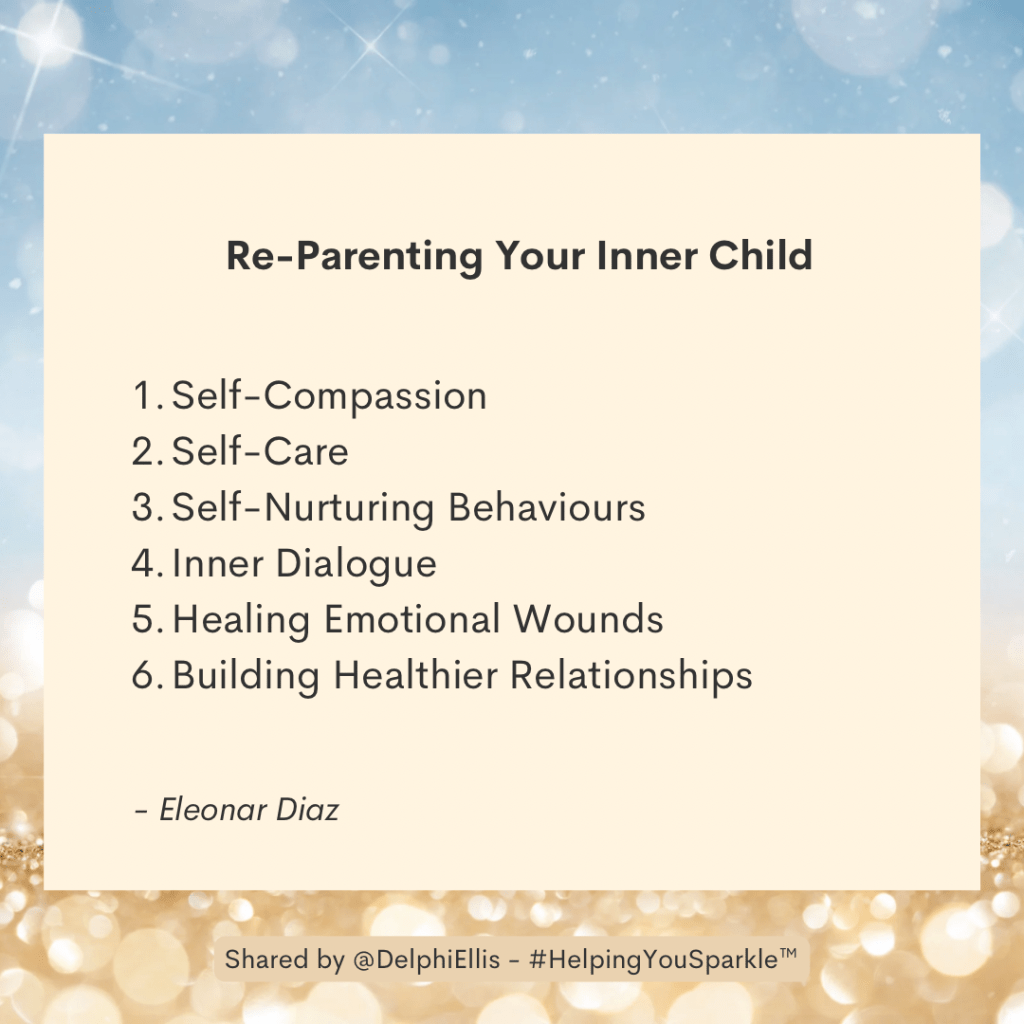
- Self-Compassion – this involves treating yourself with kindness, like you would a good friend. It also includes acknowledging and validating your emotions and experiences.
Here’s my article on self-compassion. - Self-Care – this means looking at your well-being holistically, not just taking care of our physical health, but emotionally and spiritually too. It also means prioritising peace.
Here’s my article about Self-Care for ‘Bad’ Days and another about the Circle of Wellness. - Self-Nurturing Behaviours – this might include self-soothing behaviours, meaningful affirmations and activities that can help you feel safe and boundaried.
There’s an example of a self-soothing activity on my YouTube channel - Inner Dialogue – This involves developing a compassionate and supportive inner voice that counter-acts difficult self-talk.
Here’s my article about Self-Compassion Statements. - Healing Emotional Wounds – this might include talking therapy or trauma informed practices like somatic experiencing. It might also include learning emotion regulation skills.
Here’s my article about keeping an Emotional First Aid Kit. - Building Healthier Relationships – This includes setting boundaries and fostering self-respect and self-worth.
Here’s my article on boundaries.
There are many benefits to engaging in Shadow Work. We may find that we live a more authentic, responsible and meaningful life, becoming more self-aware of our biases and unhealthy behaviours. Awareness is the first step to change, and if we want something different, we have to do something different. This can then have a knock-on effect on our relationships with others, and improve the quality of our physical health, including how well we sleep.
However, as mentioned, this process can be turbulent, messy and working to improve ourselves can feel like emotional labour. It’s not easy treating ourselves more compassionately, especially after a lifetime of unhealthy or traumatic experiences. Do what feels reasonable and meaningful for you, including therapy if it helps, go at a pace that feels useful and make your highest potential a priority.
Delphi is the author of Answers In The Dark: Grief, Sleep and How Dreams Can Help You Heal, out now on Amazon and Hive. You might also like (Monthly) Monday Mojo™. The Helping You Sparkle™ magazine is part of the Helping You Sparkle™ portfolio. References to third parties does not endorse their content. Please read these policies for details.
Copyright – Delphi Ellis 2024
 Helping You Sparkle™ Magazine
5 thoughts on “Shadow Work and Healing the Inner Child”
Comments are closed.