
Values are the things that matter most to us. You may have a clear idea of what your values are already. Many people, for example, believe that honesty is an important quality.
Values, Goals and Principles
You may find that your values, like goals, change over time.
When we are younger, for example, values and goals may centre around work, making money or starting a family. As we get older, our values might shift; we might focus instead on saving money for retirement or looking after our health.
Although goals and values can be intertwined, they are not the same.
Goals tend to have a beginning and an end; if I want to own my own home (perhaps because I have a value of security), I might create an action plan to save a deposit, look into getting a mortgage and so on.
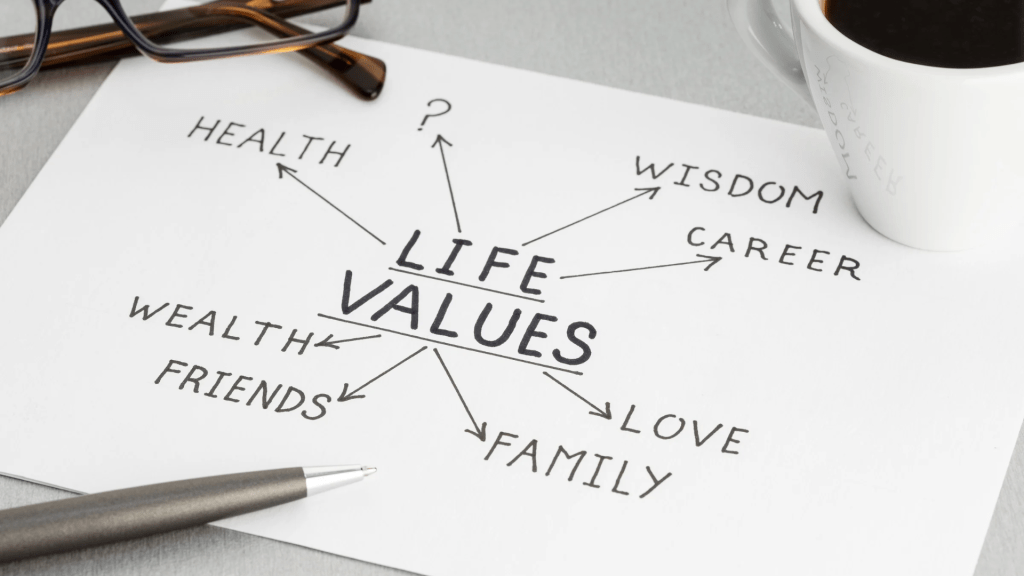
Our values can help us decide our Big Picture Goals, what we want from life and in particular what direction to take, but values tend to be a longer-term consideration than the goal itself.
For example, once the purchase of the house has gone through, the goal is achieved but the value (of security) stays the same. Values can also influence and show up in our decision making consistently, like making sure the mortgage is paid each month.
Principles, on the other hand, are the unshakable beliefs that you have and may live by. They can be our values but are unlikely to change as we get older.
For example, choosing to live life non-violently, or believing that nothing justifies war is a principle. Believing in justice is another. Honesty is a principle. and a value too.
Principles are what sets the compass for our sense of moral responsibility (eg, what feels “right and wrong”), as well as our character. They can be taught, but may feel more innate, like spirituality – they can be a sense of who we are at our deepest, soul level.
Why is this important?
Knowing our values can help us in different ways.
One is that to live life in alignment with what matters to us, can enhance our well-being.
You’ll know yourself how you felt, for example, if you walked away from a situation where you felt you “should” have spoken up, with a value of integrity. If you did speak up, you’ll feel proud of yourself, creating a sense of wellness. If you didn’t, you may have felt unwell – certainly emotionally.
Our values can also help us decide which direction we’d like (or need) to take across a number of different domains, like deciding what job we want to do, or what would give us a sense of purpose.
This is where using the Circle of Wellness can help, you can have values for each of the domains. You can use your values to map out what healthy actions you could take next.
If authenticity is important to you, for example, and you want to improve your social health, then you might seek out people who will allow you to be you. If justice is important to you, you might seek out jobs where fairness or the rule of law is applied.
Where to begin
It can be a helpful reflection activity, perhaps writing in your journal (if you have one) and using the image below, to pause for a moment and consider what your values might be. (There may be other values that matter to you that are not listed here).
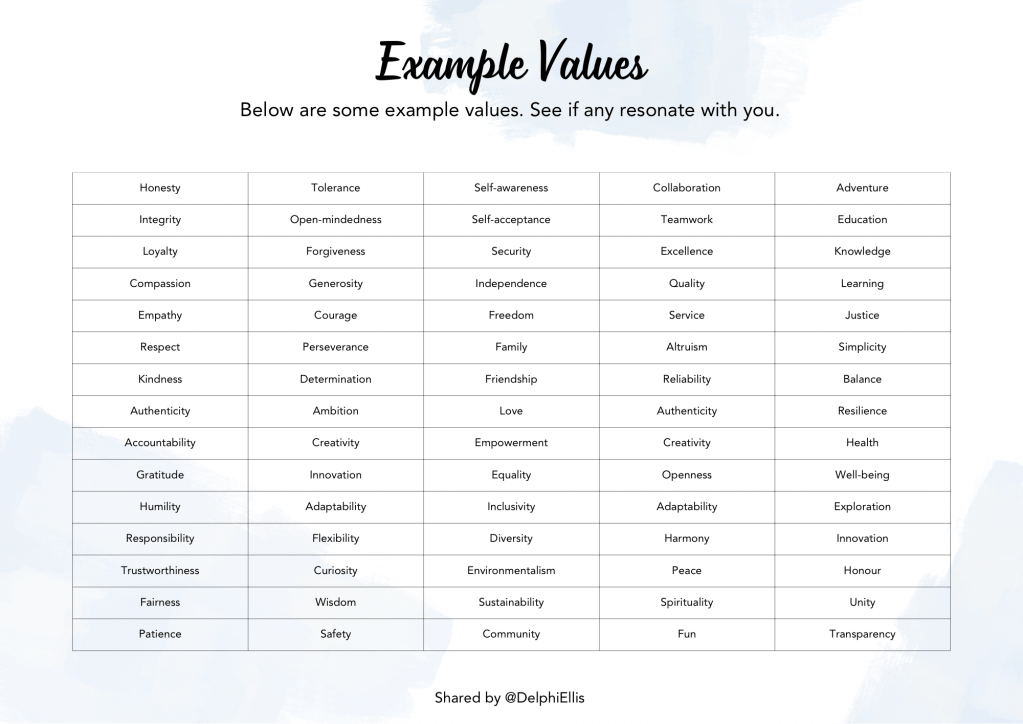
Remember though that values can change, and what matters to you today may be different in 10 or 20 years time. That’s ok, and it can be a helpful reflection activity to revisit your values at least once a year and see whether a) you’re living in alignment with them and b) if you may need to focus your attention elsewhere. You’ll know if you’re being “true” to your values consistently by how you feel each day.
Maybe take some time to think about whether your values are also a principle, and what you won’t be moved on. This may encourage you to set boundaries where needed, and communicate helpfully what you’re prepared to tolerate (or not) as well as find people who share what matters to you.
In any event, knowing your values can be an empowering journey of discovery, knowing what you want, what you need and where you’re going. Doesn’t that sound exciting!
Delphi is the author of Answers In The Dark: Grief, Sleep and How Dreams Can Help You Heal, out now on Amazon and Hive. The Helping You Sparkle™ magazine is part of the Helping You Sparkle™ portfolio. References to third parties does not endorse their content. Please read these policies for details.
© Copyright Delphi Ellis, all rights reserved


8 thoughts on “What are values and why are they important for our health?”
Comments are closed.