
Note to reader: the purpose of the articles featured in this magazine is to make emerging ideas readable. For an in-depth understanding of any topic discussed, please refer to the original authors or research of these concepts.
Have you ever noticed that you have less capacity to cope when you’ve had a dreadful night’s sleep?
Lack of a good night’s rest is just one thing that may narrow our Window of Tolerance. Our life experiences also influence how wide our window is.
This is a concept introduced by Dan Siegel in his book Mindsight, which can be discussed alongside Stephen Porges’ Polyvagal Theory, as a way of talking about managing “stress arousal” and trauma responses.
It can be helpful to recognise when your window is narrow and what might help to widen it.
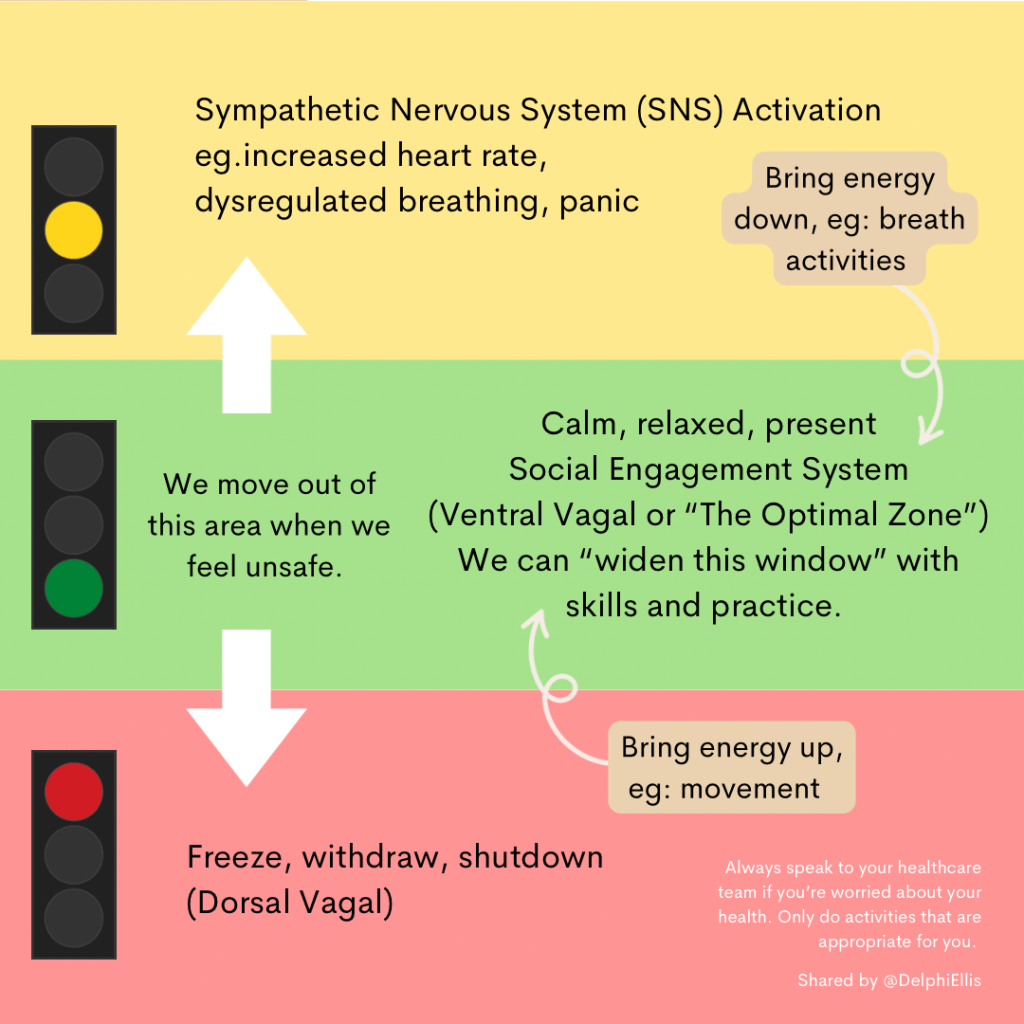
Broadly speaking, the Window of Tolerance looks at our responses from the perspective of hyperarousal, hypoarousal and the Optimal Zone. These are unpacked briefly, further down, and illustrated in the image below. As always, speak to your healthcare team if you’re worried about your health. (Keep in mind these responses can look different for everyone, depending on their experiences including racism, homophobia and other ways people are harmed simply because of their identity).

😩 Hyperarousal is when our sympathetic nervous system is activated, most commonly known as Fight or Flight. During this ‘state’, learning is almost certainly impossible as our Executive Functioning (eg. our ability to “think straight”, make good decisions and process information) goes “offline”.
Common signs of hyperarousal include increased heart rate, dysregulated breathing (i.e. we don’t breathe properly) which can lead to panic. We may feel irritable or edgy and be easily startled. In hyperarousal, we may need to bring our energy down, so breath and mindfulness activities may help including how to manage a panic attack.
😌 The Optimal Zone can be likened to Porges’ description of the Ventral Vagal state associated with social engagement. Essentially in this ‘state’, we feel safe and connected. We are calm, flexible and present. People may achieve “flow” in this state (eg. a feeling that time flies, they do their best work). We can also take in and integrate new information, and have access to our intuition. We are emotionally regulated but also have the ability to self-soothe, and generally tolerate life’s stressors.
We leave the Optimal Zone or ventral vagal state when we feel unsafe. Safety is everything to the nervous system, so creating safe spaces and having meaningful connections are important, as well as knowing what healthy coping mechanisms bring you “back to centre – and can help keep you there. This may also include setting boundaries, especially with certain people who don’t help.
😔 Hypoarousal can be likened to Porges’ dorsal vagal state. It’s associated with the freeze response but also shutdown. In this ‘state’, people may withdraw, feel numb and tune out. They may feel disconnected, depressed or shame (or all of these) and engage in self-blame.
Bringing the energy up can be important here but difficult. There has been some research that suggests time among trees (like the tradition of Shinrin Yoku) can help alleviate depression, especially combined with movement like walking, and self-compassion practices can help us be kinder to ourselves.
Of course, people may move in and out of the Optimal Zone during a day, depending on their circumstances, or they may remain stuck in one of these areas, especially following a traumatic event, which leads to further dysregulation.
The good news is with emotion regulation skills, somatic (body) awareness and an understanding of how their nervous system is operating, someone may find that they can move back to the Optimal Zone or ventral vagal state with time and practice – and especially with help. This is why co-regulation – we now know that being around someone who is calm helps us feel calm – and good community can be important too.
Practices like EFT can be useful, along with grounding techniques and any activities that help us get to know our body better like yoga or a Body Scan. If you have a difficult relationship with your body, or tuning into it, therapy may be a first step. You may also find the Four Elements exercise interesting as well as, when the time is right, engaging in your own Shadow and Inner Child work.
As always, if you’re ever in any doubt about your well-being, speak to your healthcare team.
Delphi is the author of Answers In The Dark: Grief, Sleep and How Dreams Can Help You Heal, out now on Amazon and Hive. You might also like (Monthly) Monday Mojo™. The Helping You Sparkle™ magazine is part of the Helping You Sparkle™ portfolio. References to third parties does not endorse their content. Please read these policies for details.
Copyright Delphi Ellis 2025


3 thoughts on “What is The Window of Tolerance (and How Can We Widen It)?”
Comments are closed.