
You will often see the use of affirmations promoted as a popular way of helping people overcome difficulty or to succeed in a particular area of their life. They became particularly popular around the 90s, encouraged by a famous author called Louise Hay.
But what are they, how do they help and are there other ways we can boost our well-being?
An affirmation is usually an ‘I’ statement of encouragement. People use affirmations for all sorts of reasons; they may help someone create a vision for the future or to feel reassured in a difficult moment.
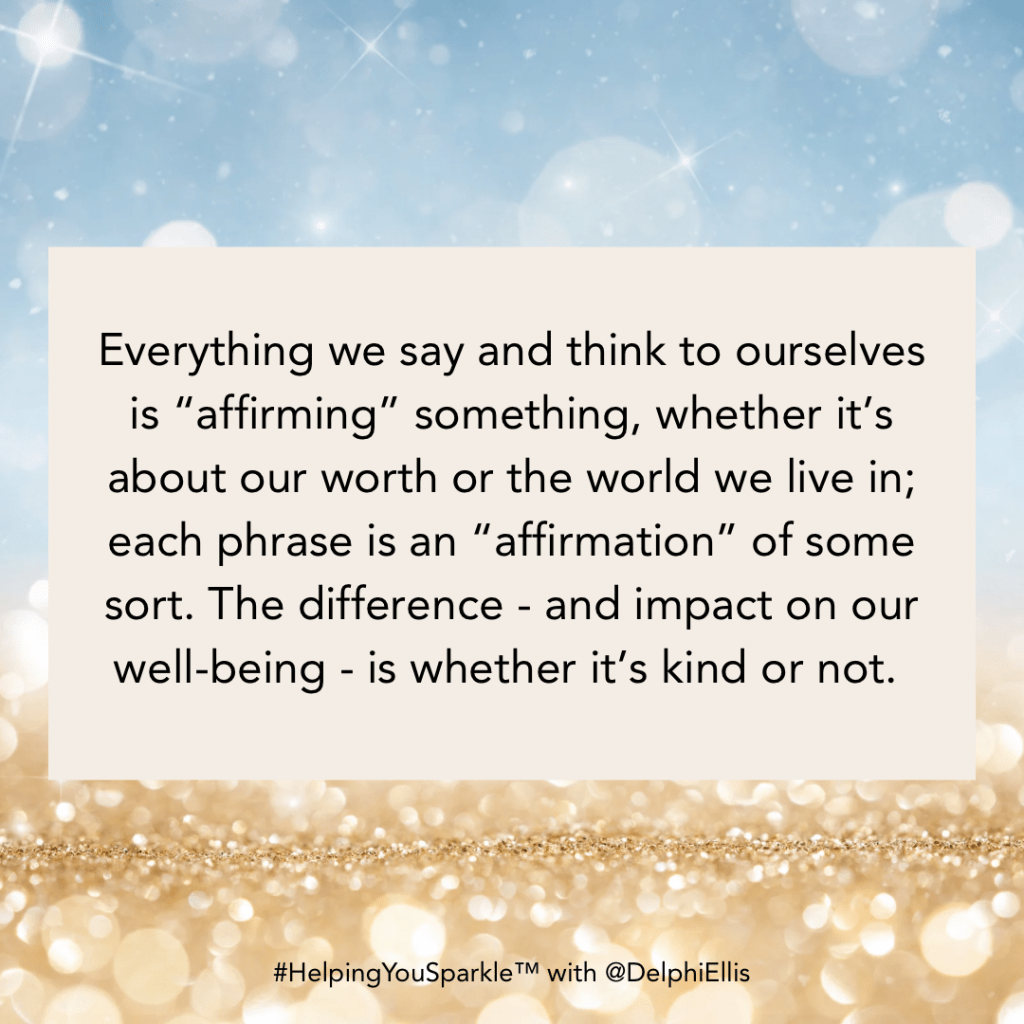
is “affirming” something, whether it’s about our worth or the world we live in; each phrase is an “affirmation” of some sort. The difference – and impact on our well-being – is whether it’s kind or not.
Affirmations are often spoken in the present tense, to help a person align with the reality they want to create. You can say an affirmation once a day, as part of an intention or a Mindful Morning routine but also as part of a self-soothing strategy (see video below), perhaps if managing a moment of overwhelm.
Example affirmations:
- I am happy
- I am healthy
- I am loved
- I am safe
- I am worthy
- I am capable of great things
- I am skilled enough to handle this
Saying “I am safe”, or “I am in a safe place” can be particularly useful if our ‘fight or flight’ response has been activated. We can use a helpful phrase to reduce the intensity of that moment. You could also try “I am ok/I will be alright” or your own version of that, if that might help.
Affirmations don’t have to be phrased just as ‘I am’ statements though, they can look like:
- I matter
- I deserve to relax
- I bring happiness and success towards me
- I make healthy choices that advance my well-being
- I give myself permission to rest/prioritise my peace/say yes (or no).
These can also be used as “compassion statements”, ways to speak to ourselves like we would a good friend. (See more examples further down).
Affirmations don’t always work for everyone, so it’s important to find what might help you (see mantras / compassion statements below). For some people, speaking in the present tense and saying “I am happy” feels unbelievable and difficult to connect with, especially if they’re having a bad day or going through a hard time.
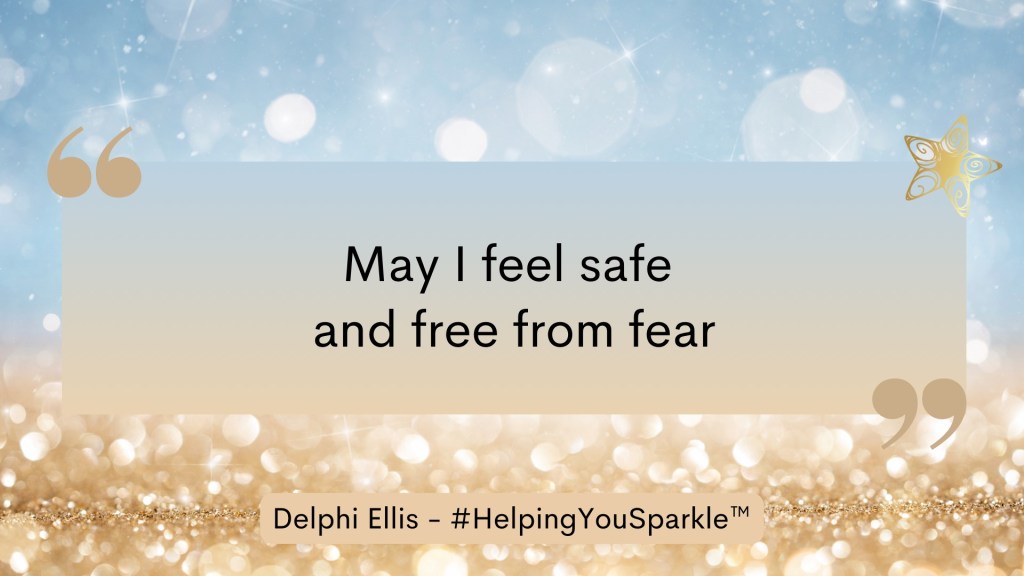
This is where adapting the affirmation’s sentence structure can be useful. If you’re not comfortable saying, for example, “I am loved” you could change the sentence structure to be aspirational, e.g. “May I feel loved”. If you can’t connect with “I am safe” you could say “May I feel safe”. (You can save the image below to your phone for your personal use, if it’s helpful.)
Compassion Statements
Research by Professor Paul Gilbert, Dr. Kristen Neff, Dr. Chris Germer and colleagues, tells us that self-compassion is an important part of our well-being and recovery, particularly if we have a critical or noisy mind. Being compassionate towards ourselves is a way to regulate our nervous system and speak to ourselves like we would a good friend.
Self-compassion practices and Compassion Focused Therapy, can include affirmations. Where affirmations tend to be ‘I’ statements, compassion statements can be flexible in their structure while challenging some negative assumptions we might make about the world and people in it. They can also help us to be compassionate to the world around us, not just ourselves, so that we can gain more patience and understanding for others.
Where for example, a person has a dominant thought that the world is unsafe, they might say “There are many safe spaces I can occupy”. Other examples might include:
- There are generous people in the world, I am one of them
- Compassion towards myself isn’t selfish; it’s valuable and necessary
- People appreciate my smile/sense of humour/wisdom
- Perfection is overrated; no one has to be perfect
- My feelings are valid, it’s how I express them that counts
- It’s ok to say no/set boundaries/make my needs a priority
You wouldn’t say “you have to be perfect” or “your feelings don’t matter” to someone you care about…so why say it to yourself?
What is a Mantra?
According to the Chopra Centre, “The word mantra can be broken down into two parts: “man-,” which means mind, and “tra,” which means transport or vehicle. In other words, a mantra can help you “transport the mind” to a calmer place, rather than being caught up or hooked in a cycle of unhelpful thinking. Mantras can be used as part of your mindfulness or wellness toolkit, especially when you’re going in to or navigating a tricky situation.
A mantra can be a word or phrase – even a sound – that can be repeated as many times as feels helpful, as many times a day as you like and for as long as is valuable. The deep vibrational nature of the Om sound, for example, can feel as if it’s having a healing, relaxing effect. If you want to, have a listen to the ‘Om’ sound chanted in the (third party content) video below. You’ll see the video is three hours long. (Only listen if this feels like it might be helpful for you).
In the Buddhist tradition, other mantras are also repeated, like the one made famous by Tina Turner: Nam-myoho-renge-kyo.
You are probably already using a ‘mantra’ in the context of a ‘go-to’ phrase when things are difficult. Many people, for example, use the phrase “It is what it is”.
As with the Om sound, mantras don’t have to be long phrases, they can be a single word like “calm, peace, relax”, The video offers a ‘tapping’ activity you can use, with these words in mind.
Other mantras that people might already use include:
- This will pass/ this feeling is temporary
- (Repeating a short sentence) e.g. It’s ok, it’s ok, it’s ok.
- Everything is / will be alright
Some people find it particularly useful to write phrases on cards and post them around their living space, or keep them as notes in their phone so they can be accessed when needed. You might decide to create some of your own that sit right with you, and practice them regularly so they’re there when you need.
Of course, some of these statements will overlap in that they can be an affirmation, mantra and compassionate all at the same time; the key is how helpful you find them. All can be useful for working towards our happiness, well-being and as part of our spiritual intelligence , in the same way as they can be used to help manage difficult moments.
Not everyone is a fan of affirmations and that can make sense. It can feel fake to look in a mirror and say “I love myself” if that’s quite far from the truth (Louise Hay called this “Mirror Work”). But here’s the thing: everything we say and think to ourselves is “affirming” something, whether it’s about our worth or the world we live in; each phrase is an “affirmation” of some sort. The difference – and impact on our well-being – is whether it’s kind or not.
So even if you feel you can’t look in the mirror and say a few kind words to your face right now, maybe think about what you won’t say to yourself anymore?
Always do what feels healthy for you.
Delphi is the author of Answers In The Dark: Grief, Sleep and How Dreams Can Help You Heal, out now on Amazon and Hive. You might also like Monday Mojo™. The Helping You Sparkle™ magazine is part of the Helping You Sparkle™ portfolio. References to third parties does not endorse their content. Please read these policies for details.
© Delphi Ellis 2024 – please note this content may also appear elsewhere as promotional material for Answers In The Dark.
 Helping You Sparkle™ Magazine
8 thoughts on “What are Affirmations, Mantras and Compassion Statements? (Examples included)”
Comments are closed.