
Whether you’re someone who has high hopes and big ambitions or just wants to settle on a particular direction in life right now, you may have been wondering how to get started.
A Vision (Action) Board is a great way of putting your aspirations into a visual display to help you decide, and stay focused on your plans for the weeks or months ahead.
What are the benefits?
The purpose of a Vision Board primarily may be to help you formalise your intentions and keep them available to you as a gentle reminder of the goals you want to achieve.
We have touch points throughout the day which can either take us further towards – or away – from the life we want to live. Having a visual display of aspirations that you see regularly may help influence the choices you make each day, to help you stay focused on what you want. It can also act as a motivator whilst at the same time keeping you on track.
What does it cost?
You don’t need a lot of money – if any – to create a Vision Board. You can use apps like Pinterest, create collages (eg in Canva, see below) or use recycled A4/A3 card and some glue (if you’re sticking images on it).
You might decide to invest in a new notebook instead, and use different coloured pens to draw borders and shapes for each topic, or to accentuate particular words or phrases you use. This may be particularly useful if you have some favourite sayings or affirmations you want to include.
Some people use pictures from magazines or print family photos or favourite quotes, but others may draw inspiration by using different headers like “Physical, Spiritual” (see below) and write what they want to achieve under each.
What to include
You can put whatever you want on your Vision Board – because it’s yours – that you feel will help to motivate you whether it’s words or photos.
You might get started by using a Wheel of Life or the Pillars/Dimensions/Circle of Wellness which I’ve included in the image below.
This is where you can consider different areas of your life and “score” each one , on a scale of 1-10 (10 being “life is amazing” in that area) to help you decide which one you’d like to make a priority. For example if you score “8” on physical health, but “6” on Spiritual, you may choose to do your Vision Board to focus on the spiritual aspect of your life.
You could do one Vision Board per area, or have one version which includes key things that might help you succeed.
However it doesn’t need to be that varied. You could if you wanted just have one that focuses on the specific car, job or holiday you want.
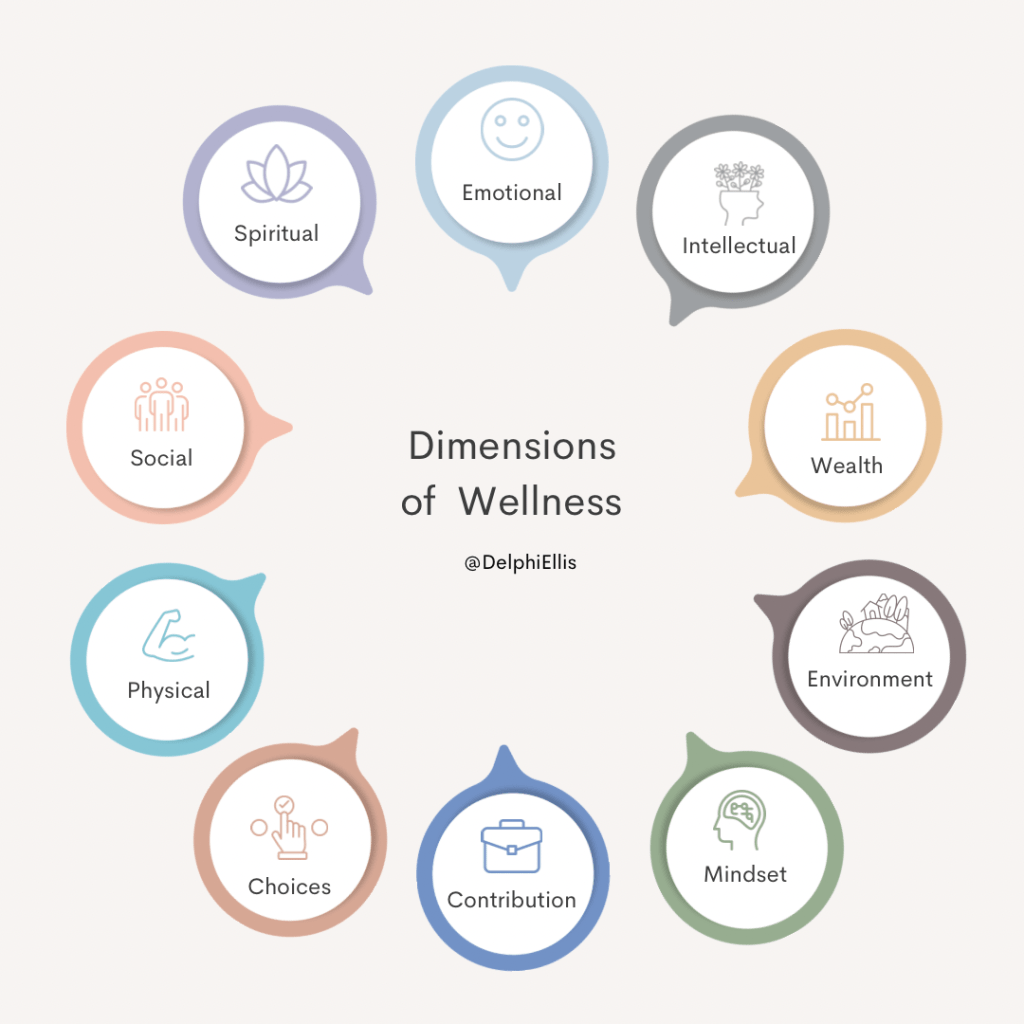
Topics you might feature on your Vision Board:
- Physical – this doesn’t just mean exercise; it might be lifestyle, and how well you eat and sleep. (If you’re having problems sleeping or having weird dreams you might like my book Answers In The Dark: Grief, Sleep and How Dreams Can Help You Heal.) Keep in mind exercise doesn’t necessarily have to mean a high intensity workout either, it could include dancing round your kitchen or doing some gardening. This area might also include how well you recognise your early warning signs that you’re not ok (like heart pounding, or shallow breathing) so that you can get ahead of managing how that makes you feel (see below).
- Emotional – this area might focus on improving our emotional intelligence. Eg., how well do you know what you’re feeling when you feel it? Can you label your emotions helpfully? Can you distinguish between feeling stressed, and feeling anxious, for example? How good are you at reading your own or others emotions and responding helpfully? How good are you at managing your emotions?
- Mindset (Psychological) – this may mean looking at the way you think and whether or not you have a noisy inner critic. How do you speak to yourself when you make a mistake and what changes can you make to treat yourself more kindly? (All humans make mistakes, so learning self-compassion can be key).
- Intellectual – some think of this as intelligence, and there’s definitely some benefit in knowing how to read maps or solve a puzzle, but this can’t also include engaging in nourishing conversations or stimulating work that feeds your soul (see Spiritual). It can also include curiosity, eg. what topics get you excited to learn about? Are there particular topics that fascinate you? Are there things you want or need to learn or improve to help you achieve your goals?
- Choices (Behavioural) in the dimensions of wellness can include intellectual, eg. are you curious about the decisions you make and how (or why) you make them? As well as considering why we do what we do, health in this domain could include the impact of our decision making and making conscious choices to behave more healthily.
- Social (incl. Relationships) – This includes your tribe, the people you spend time with. This doesn’t always mean just friends or family, it might also include colleagues and associates. How would you rate your social wellness right now? Do the people in your life lift you up, or bring you down? This also doesn’t always mean going out and partying. You might decide to try a college course, take up a new hobby or start some volunteering. From the Intellectual perspective above, this might also include people you can have deep and meaningful conversations with, which can also be quite a spiritual experience.
- Contribution (Occupational) – what do you want to achieve professionally? Do you feel appreciated and are you using your skills meaningfully? When do you feel “in the zone”? (Again, see also Spiritual). Do you know what your strengths are (in all areas of your life) and can you articulate them? Do you recognise the transferable skills you have between home (eg, from planning a meal to parenting) and work, like juggling diaries/managing money and conflict resolution? Occupational doesn’t necessarily mean paid work, so could mean volunteering too.
- Wealth (Financial) – this might be anything from being able to save money, cover your bills regularly, invest in a business, buy a house or clear some debt. If you’re struggling with your finances, you may also find these links useful.
- Spiritual (incl. purpose and passion)– this is not always about religion, it might be about where you feel most connected. It might also include setting an intention to meditate more, spend time in nature or improve your Spiritual Intelligence (SQ). What connects you to the world around you? This might also include your sense of purpose which isn’t always about what you get paid for (although it might be) but more about being of service. Perhaps think about when you feel what Mihaly Csikszentmihalyi popularly referred to as “flow”, the state of being “in the zone”. This might be when organising a family get together or engaging in a favourite sport. What are you doing when you feel fulfilled or as if “time flies”?
- Environmental can include whether you’re eco-friendly, and whether you make ethical choices for example when buying food, clothes or when travelling – but it might also include our literal environment. For example is your living space cluttered? Does it feel like a sanctuary? What can you to do improve this if needed? Is the environment and spaces you occupy themselves healthy, or is there a culture of bullying, racism or misogyny?
Once you know what you want on your Vision Board, you can choose a design that fits your aspirations and begin.

Where to keep it
This will depend on whether or not you want to use a physical Vision Board or a digital one.
Apps have been mentioned (Pinterest can be great for that) but if you’re going to use your phone it’s important to keep the Vision Board where you can see it. You might save it as your Lock Screen as one example. If you’re going to have a paper version, then again keep it where you can see it every day, like your kitchen. If you choose to have a paper version, you can still take a photo and keep it as the wallpaper on your phone.
The more you see your Vision Board and it reminds you of what you want to achieve, it can influence the touch points you have throughout the day that help you to make better decisions in line with your goals.
How long to keep a Vision Board
It’s really up to you. You might decide to do a new one each month, every year or review periodically. You could do a Vision Board for the next 12 months or the next 10 years. You might decide to refresh it periodically because your hopes might shift, or you find you need to try a different direction of travel. Do what feels right and healthy for you.
If you decide to do a written Vision Board, as described above with headings and writing under each topic, this might be part of your regular journalling practice and so again, you can review it periodically.
This is a good video from Freedom Kingdom with some more ideas. I hope you enjoy this process if you choose to try it.
Delphi is the author of Answers In The Dark: Grief, Sleep and How Dreams Can Help You Heal, out now on Amazon and Hive.
Copyright Delphi Ellis 2022, updated 2023


12 thoughts on “How to Create a Vision (Action) Board”
Comments are closed.