
This is a concept discussed by Françoise Mathieu in her workbook on Compassion Fatigue. It can be a useful way to help people measure how they’re feeling and whether or not it’s time to reset and recharge. If you’re beginning the process of recognising your ‘early warning signs’ of when you’re not ok this can also provide insights on what to do next. Everyone is different so do what’s right – and healthy – for you.
You could set a reminder in your device throughout the day so that you can check in periodically to see where you are on the traffic light system.
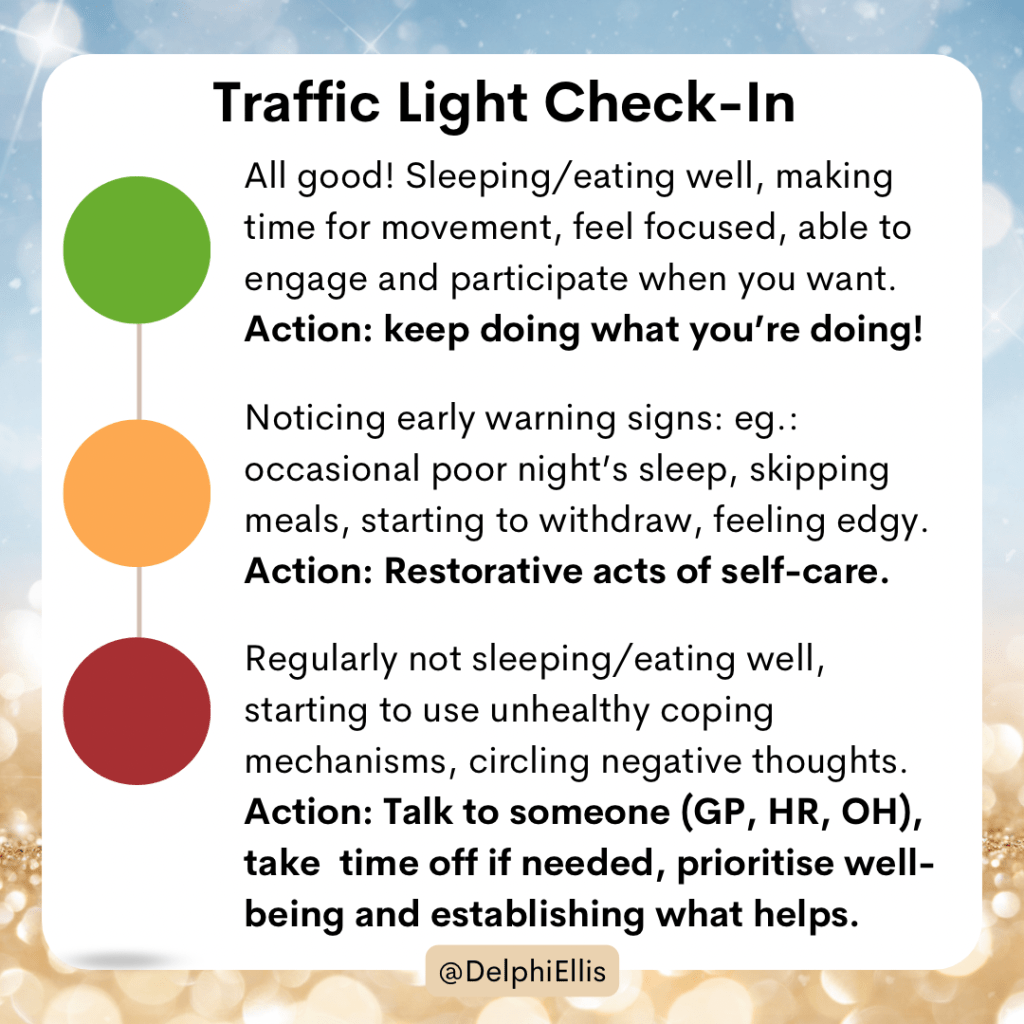
🟢 = All good: you’re sleeping and eating well, and making time for movement; this doesn’t always have to be exercise, it could be a walk/gardening/even dancing round your kitchen. Your social circle will be supportive and helpful and you lean in for help when needed. You’ll be able to concentrate and engage with people when you want. You’ll be setting healthy goals and might even have a vision for the future.
Action: Keep doing what you’re doing! Note: it’s just as important to engage in self-care when you’re doing well, as it is anywhere else, especially if you’re busy. In fact, your self-care might be one of the reasons you’re doing ok.
🟠 = Starting to notice some early warning signs, eg., occasional poor night’s sleep, skipping meals now and then, starting to feel ‘edgy’. You may be finding it hard to concentrate at times, and occasionally withdrawing from social settings – not because you don’t want to join in (we can all experience the Joy of Missing Out) but more because you’re feeling a bit embarrassed that you’ve let things slide..
Action: Start to engage in restorative acts of self-care especially if you’re starting to notice more bad days. This may include talking to people about sharing the load, or even the little things like changing your bedding and having an early night. Ironically the very things that can help us feel better (like eating healthy and regularly) tend to be the first things that go out of the window when we’re not ok. However, try if you can to stick to healthy routines that you know work for you.
Also check your Rules for Living: have you got caught up in the notion that resting is ‘lazy’? If so, it’s probably time to challenge that narrative.
🔴 = Feeling like you’re really not ok: You’ll be regularly not sleeping well, missing meals more often than not, you may be ‘numbing out’ with unhealthy coping strategies. You may well have ‘shut down’ and be avoiding people because you’re feeling shame that you’re not coping.
Action: It may be time to stop, reach in to sources of help (eg GP, Occupational Health, Employee Assistance Programme) and start to make more room for self-care and prioritise your well-being. Recovery will look different for everyone, so don’t be put off by other people’s idea of what that might look like. You might also consider the Self-Care Check-In, which features in my book Answers In The Dark; have a look at the video that explains more. There’s also a list of links that may be useful here.
Most of all, be compassionate towards yourself and speak to yourself like you would a good friend. Unhealthy comparisons – measuring our worth and value by someone else’s yard stick – can cause us to feel like we’re falling short, when actually many people might be in a similar boat. You might be surprised if you reach in for help, that others can relate and provide a supportive network. You might write some affirmations that focus on your wellness and engage in mindfulness activities. Self-care is often in the little things, a warm bath or reading a book all count. Always do what feels healthy for you.
Delphi is the author of Answers In The Dark: Grief, Sleep and How Dreams Can Help You Heal, out now on Amazon and Hive. You might also like Monday Mojo™. The Helping You Sparkle™ magazine is part of the Helping You Sparkle™ portfolio. References to third parties does not endorse their content. Please read these policies for details.
© Delphi Ellis 2024 – please note this content may also appear elsewhere as promotional material for Answers In The Dark.
 Helping You Sparkle™ Magazine
2 thoughts on “The Traffic Light Check-In: A tip for measuring your well-being”
Comments are closed.