
Over the decades, there have been many ideas about what it means to “live well”; ultimately “good living” looks different for everyone.
But when thinking about wellness, a holistic view provides a platform to start from, especially when thinking about goal setting for a healthy and meaningful life.
While there has generally been a strong focus on physical health for a long time, and more recently a person’s mental wellness – both appropriate – a wider view of well-being can be helpful. For example, recognising the importance of our spiritual health and spiritual intelligence can be a valuable part of the Mind, Body, Soul conversation.
This is where an adapted version of the Wheel of Life can be useful, to incorporate the Dimensions of Wellness including other areas like occupation (contribution), finances (wealth£) and spirituality. The dimensions or “pillars” of wellness can form a circle, because they may each influence another, and are a way of thinking about our Big Picture Goals.
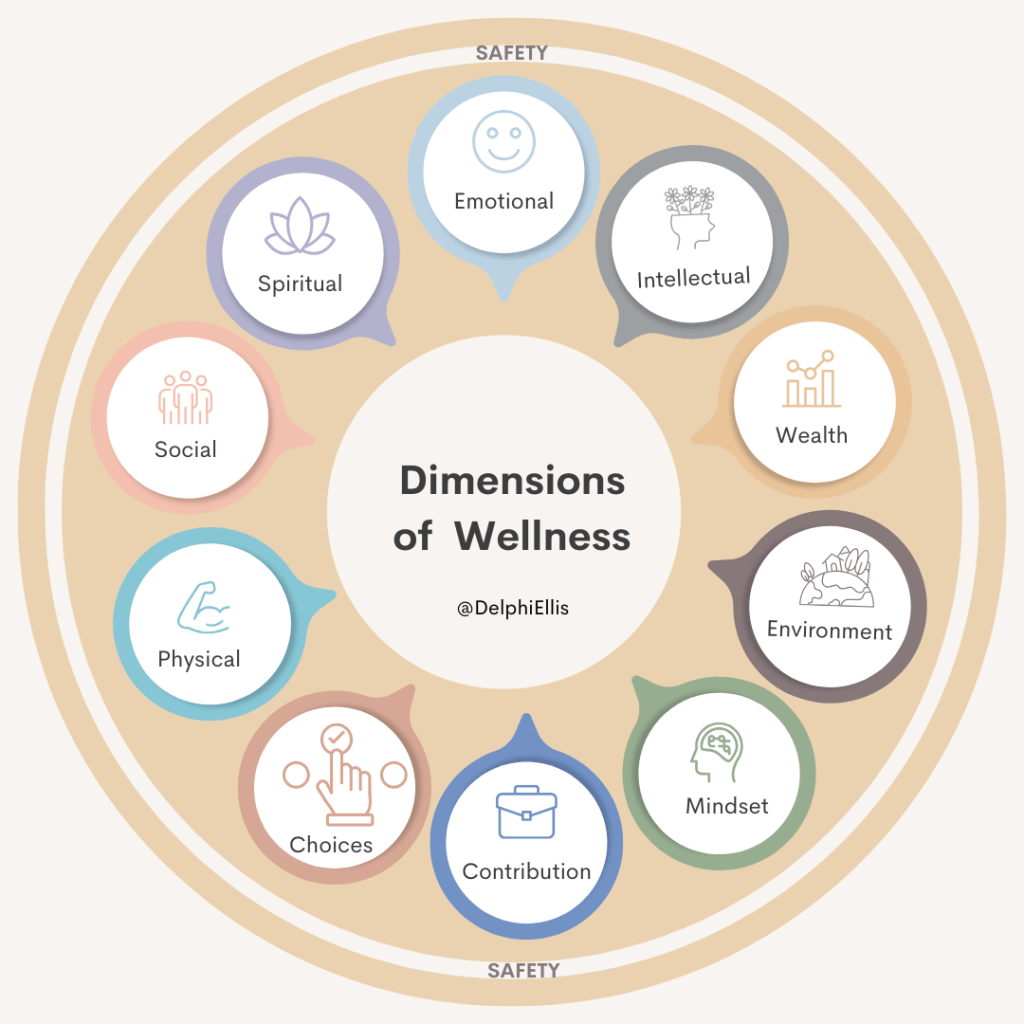
There are many variations of the Wheel of Life and it has long been used as a coaching tool to help people move forward and achieve success. This version includes a number of different areas aligned with the Circle of Wellness that can also be used to create a Vision Board. All of this also includes dimensions of safety.
How to Use this Wheel of Life
Using the diagram below as a template, if it’s helpful, score on a scale of 1-10 where you feel you are in each of the dimensions and think about what score you’d like to achieve realistically in the next month/year or whatever achievable time frame you have in mind. Then, looking at your completed wheel; you could use this information to decide which areas will be a priority.
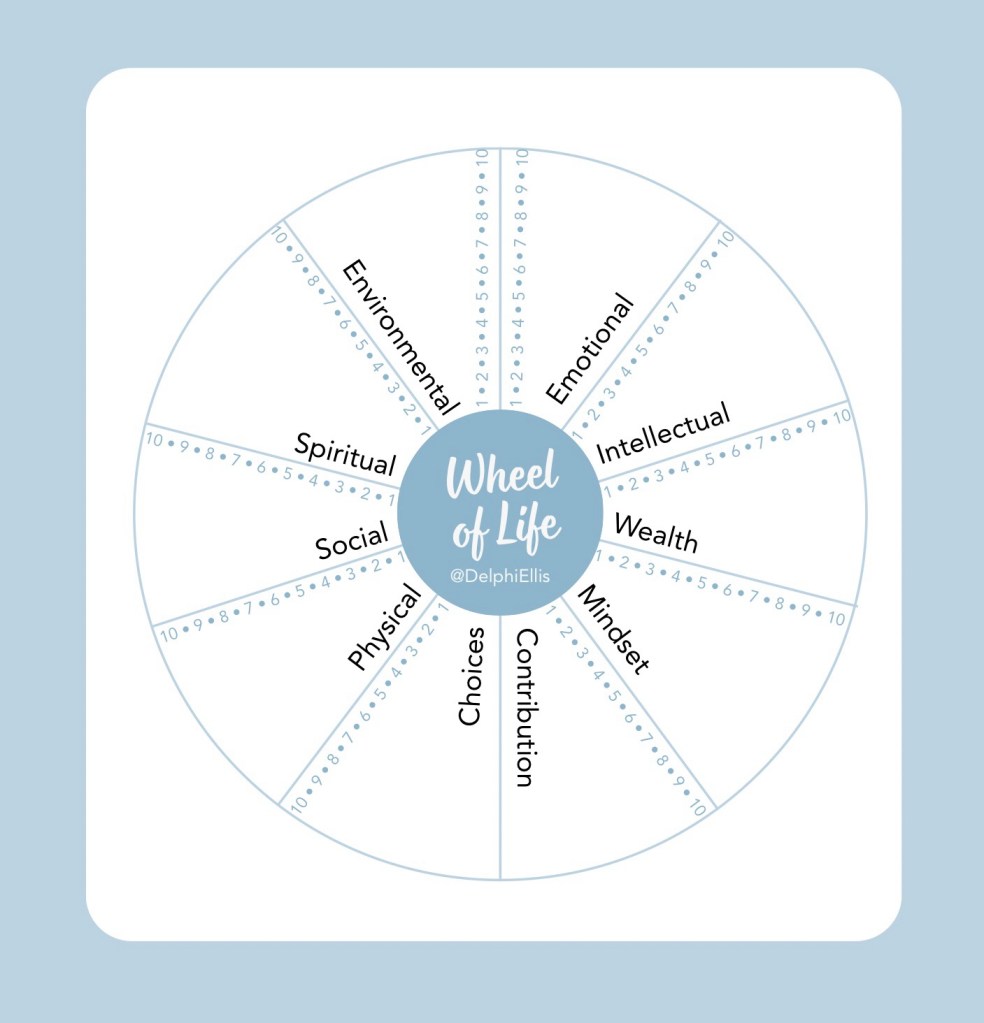
As the images show, many of these areas are connected, for example intellectual or occupational health can be aligned with spiritual, especially if intellectual or occupational wellness provides a sense of meaning or purpose.
It’s important to note that it you score lower in one area of wellness, this doesn’t mean that has to be your focus – you decide what will work for you. Example: let’s say you score six on physical health and four on psychological health, and would ideally like to achieve an eight in both. You might decide to prioritise your physical health, perhaps by starting Yoga, which in turn improves your psychological health.
Develop a plan with helpful timeframes and don’t forget to include what resources you may need – whether that’s talking to a friend, borrowing a book from the library, or starting a new course – to help you get ahead.
Here are some ideas (included in the Vision Board activity too) suggesting how you can work with each dimension, remembering also the role of safety.
- Physical – this doesn’t just mean exercise; it might be lifestyle, and how well you eat and sleep. (If you’re having problems sleeping or having weird dreams you might like my book Answers In The Dark: Grief, Sleep and How Dreams Can Help You Heal.) Keep in mind exercise doesn’t necessarily have to mean a high intensity workout either, it could include dancing round your kitchen or doing some gardening. This area might also include how well you recognise your early warning signs that you’re not ok (like heart pounding, or shallow breathing) so that you can get ahead of managing how that makes you feel (see below). It might also include the power of (and giving yourself permission) to make space for “play”, something we now know is important for our well-being.
- Emotional – this area might focus on improving our emotional intelligence. Eg., how well do you know what you’re feeling when you feel it? Can you label your emotions helpfully and can you distinguish between feeling stressed and feeling anxious, for example? How good are you at reading your own or others emotions and responding helpfully? How good are you at managing your emotions?
- Mindset (incl. Psychological) – this may mean looking at the way you think and whether or not you have a noisy inner critic. How do you speak to yourself when you make a mistake and what changes can you make to treat yourself more kindly? (All humans make mistakes, so learning self-compassion can be key)
- Intellectual – some think of this as intelligence, and there’s definitely some benefit in knowing how to read maps or solve a puzzle, but this can’t also include engaging in nourishing conversations or stimulating work that feeds your soul (see Spiritual). It can also include curiosity, eg. what topics get you excited to learn about? Are there particular topics that fascinate you? Are there things you want or need to learn or improve to help you achieve your goals?
- Choices (Behavioural) in the dimensions of wellness can include intellectual, eg. are you curious about the decisions you make and how (or why) you make them? As well as considering why we do what we do, health in this domain could include the impact of our decision making and making conscious choices to behave more healthily.
- Social (incl. Relationships) – This includes your tribe, the people you spend time with. This doesn’t always mean just friends or family, it might also include colleagues and associates. How would you rate your social wellness right now? Do the people in your life lift you up, or bring you down? This also doesn’t always mean going out and partying. You might decide to try a college course, take up a new hobby or start some volunteering. From the Intellectual perspective above, this might also include people you can have deep and meaningful conversations with, which can also be quite a spiritual experience.
- Contribution (incl. Occupational) – what do you want to achieve professionally? Do you feel appreciated and are you using your skills meaningfully? When do you feel “in the zone”? (Again, see also Spiritual). Do you know what your strengths are (in all areas of your life) and can you articulate them? Do you recognise the transferable skills you have between home (eg, from planning a meal to parenting) and work, like juggling diaries/managing money and conflict resolution? Occupational doesn’t necessarily mean paid work, so could mean volunteering too.
- Wealth (Financial) – from being able to save money, cover your bills regularly, invest in a business, buy a house or clear some debt. If you’re struggling with your finances, you may also find these links useful.
- Spiritual (incl. Purpose and Passion) – this is not always about religion, it might be about where you feel most connected. It might also include setting an intention to meditate more, spend time in nature or improve your Spiritual Intelligence (SQ). What connects you to the world around you? This might also include your sense of purpose which isn’t always about what you get paid for (although it might be); being of service can be an incredibly healing and spiritual experience. Perhaps think about when you feel what Mihaly Csikszentmihalyi popularly referred to as “flow”, the state of being “in the zone”. This might be when organising a family get together or engaging in a favourite sport. What are you doing when you feel fulfilled or as if “time flies”?
- Environmental can include whether you’re eco-friendly, and whether you make ethical choices for example when buying food, clothes or when travelling – but it might also include our literal environment. For example is your living space cluttered? Does it feel like a sanctuary? What can you to do improve this if needed? Is the environment and spaces you occupy themselves healthy, or is there a culture of bullying, racism or misogyny?
We might also now include Cyber wellness in this circle, and how well we are looking after ourselves in terms of things like how much time we spend on social media, although this could also sit under other dimensions in the context of our ability to think critically about information we read and absorb.
The Wheel of Life activity, aligned with the Circle of Wellness this way, recognises that our well-being is inter-connected and that you can set goals based on which areas you may want to prioritise, and these may change over time. You can revisit the wheel when you need, in the same way as you can redesign your Vision Board as and when it’s helpful or adjust your goals as life changes. The important thing is not to put yourself under so much pressure that it takes you off course or slows you down. See the Wheel of Life instead as a springboard to take you towards the life you want to life.
Always do what’s right for you and if you’re worried about your well-being, have a chat with your doctor.
Delphi is the author of Answers In The Dark: Grief, Sleep and How Dreams Can Help You Heal, out now on Amazon and Hive. This website is part of the Helping You Sparkle™ portfolio.
Copyright Delphi Ellis, Updated 2025
 Helping You Sparkle™ Magazine
13 thoughts on “The Circle of Wellness: How to Use the Wheel of Life for Meaningful Living”
Comments are closed.