
This list was compiled with the help of my Facebook group, and is offered with my personal thanks for the contributions made.
It goes without saying that Self-Care for Busy People and Self-Care for Bad Days, can be important strategies for navigating a hectic world, especially in difficult moments. You can’t pour from an empty cup and you can’t give people energy you don’t have.
But what really helps to stay sane and serene?
Below are some ideas that members of my Facebook group say they have found useful and actually work. Of course, this list isn’t exhaustive, and what works for one might not work for another. (Please also note links are provided for interest only; they may contain promotional content, which is not endorsed).
1. 📖 Reading
According to Mental Health First Aid England, reading is not only a restorative act of self-care that can provide “healthy escapism” but it helps us relax and reduce stress.
Researchers found that reading for just six minutes a day can lower stress levels by up to 60%. You might decide to revisit a favourite novel, or look out for a self-help book that interests you.
2. 🌳 Walking in nature
The benefits of spending time in nature are now well established, not just for our mental health, but across the dimensions of wellness, including our physical and spiritual health too.
Dr Qing Li who has written books on Shinrin Yoku, the Japanese tradition of Forest Bathing, explains that 85% of people said time in nature boosted their happiness, with others saying it helped to reduce anxiety.
3. 🎨 Art Journaling
We know that writing down how we feel, what we’ve achieved during the day or even tracking how much sleep we’ve had through journalling, can be helpful for our well-being. But not everyone finds it easy to use words to describe what they think or how they feel, and may prefer to use different forms of art to put their ideas on to paper. This might include a Vision (or Action) Board.
The good news is “There is no such thing as bad art, only art”, so it really doesn’t matter whether you feel you can draw or not to give your thoughts and feelings a platform. You might doodle, use collages or create your own style of art. You might have a look to see what classes are nearby to you.
4. 🎵 Listening (and dancing) to music
Evidence now suggests that music therapy has a positive effect on depression, anxiety and quality of life, but you may have also experienced a time yourself where just listening (or dancing) to a song helped lift your spirits.
You might decide to set up a playlist on your phone containing feel-good music that helps you sparkle, consider learning to play an instrument or perhaps finding a music therapist in your area.
5. 🫖 Having a cuppa
There’s been some fascinating discussions emerging from the science of Polyvagal Theory, and around somatic practices which centre on regulating the nervous system. One of which suggests that having a warm drink can actually help calm the body and mind.
Making this part of your mindful morning routine might also help set you up for a calmer, and more peaceful day ahead. (See also below).
6. 🦋 Watching “wildlife”
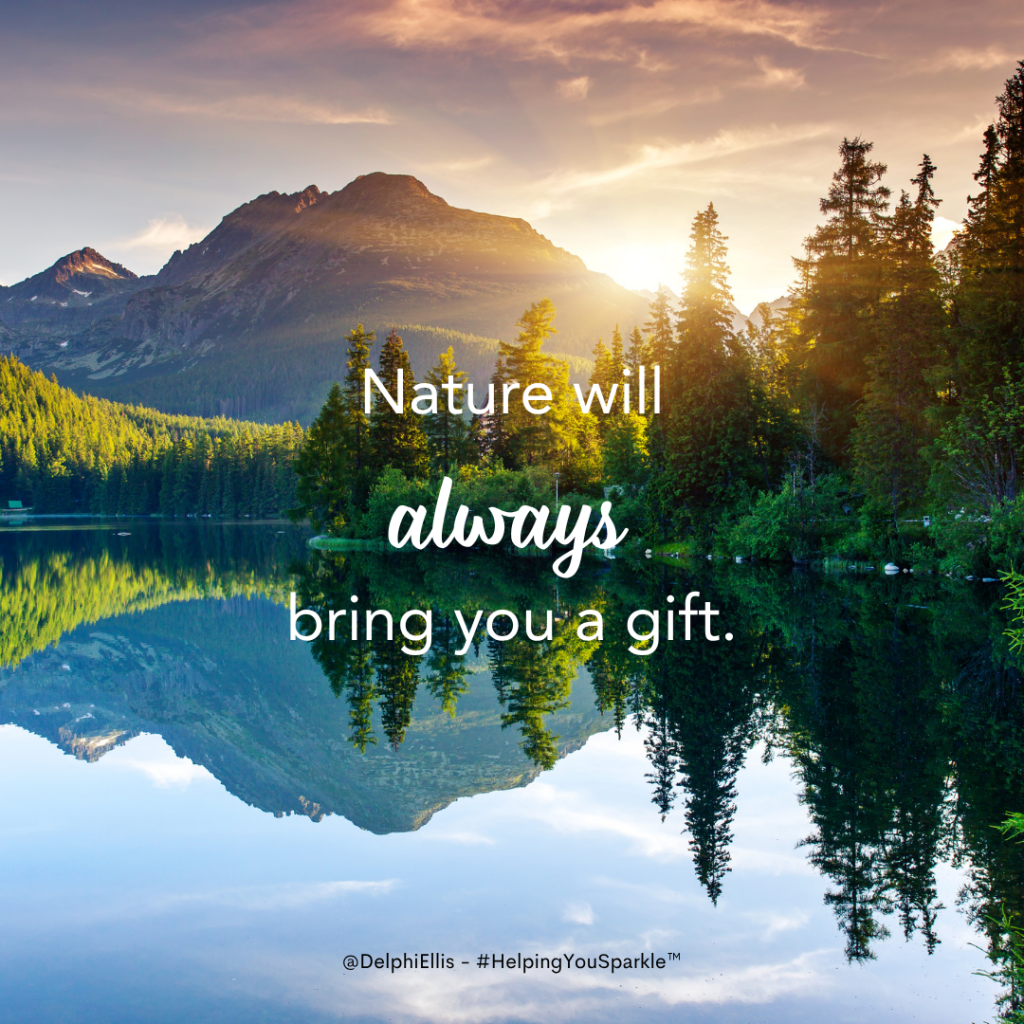
If we take the time to look, nature will always provide a gift, which can help improve our mental health. According to one study, tuning into nature to count butterflies, for example, was shown to help reduce anxiety.
🐦⬛ You might also watch or feed the birds as part of your mindful morning routine. Research from the Institute of Psychiatry, Psychology & Neuroscience (IoPPN) at King’s College London has also found that seeing or hearing birds is associated with an improvement in mental wellbeing that can last up to eight hours.
7. 🕯️Lighting some candles
Hygge is a trend, particularly popular in Denmark – known to be one of the happiest countries in the world – that offers a range of ideas that endorses self-care, slowing down and the benefits of presence (eg, through mindfulness) while promoting time in nature (see above) and a sense of community too.
One popular way of practicing Hygge, is to have areas of soft lighting (like fairy lights) or perhaps lighting some candles (scented is optional), within the home. In fact, the practice of using candles is thought to be so popular, that the Danish word “lyseslukker” (meaning spoilsport) can also be translated as “one who blows out the candles”!
8. 🤲 Having a massage
There is some fascinating science emerging around Healing Touch, an energy therapy that uses light touch or close-to-the-body touch to support and facilitate physical, emotional, mental, and spiritual health. There have also been a growing number of Cuddle Therapists, a type of platonic touching and structured practice where practitioners offer comforting, consensual physical contact in a non-sexual setting.
Traditional massage therapy has also been proven to have a number of benefits, particularly lowering stress levels, and it isn’t just something exclusive to a spa day. You could check for recommendations within your area for the types of service mentioned here, that are within your budget.
9. 🛁 Enjoying a warm bath
This might be one of the most common forms of self-care people appreciate, especially if it’s followed by getting in to clean sheets on the bed (changing your bedding is also an act of self-care).
As well as the bath (or shower) itself, you could incorporate other restorative acts of self-care like trying a face mask or other facial routine, listening to a radio or music playlist, as well as lighting some candles (see above).
10. 🗣️ Meeting up with a friend
There’s a common misconception that self-care should be done alone, but actually it could include having a cuppa (see above) with a friend. A problem shared is a problem halved, and you may be able to let off some steam in a meaningful way.
Choose your circle carefully though (social health is an important dimension of wellness), for example make sure friendship groups match your values and leave you feeling energised after a good old catch up.
As always, do what feels right for you.
Delphi is the author of Answers In The Dark: Grief, Sleep and How Dreams Can Help You Heal, out now on Amazon and Hive. The Helping You Sparkle™ magazine is part of the Helping You Sparkle™ portfolio. References to third parties does not endorse their content. Please read these policies for details.
© Copyright Delphi Ellis 2025
 Helping You Sparkle™ Magazine
You must be logged in to post a comment.