
Note to the reader, this article makes reference to trauma and alludes to violence, including abuse. Please take care of yourself if you choose to read this article, and keep in mind these Terms and Conditions of use. You may find this list of links useful.
If you’ve followed this magazine for a while you’ll know it approaches well-being holistically; this includes expanding conversations to include things like our spiritual health, not just our physical and mental wellness.
An important part of wellness work can also be to understand that, as humans, our primary concern, around the clock, is feeling safe – even if at a level below conscious awareness. In Polyvagal Theory, Stephen Porges refers to this as Neuroception; how the brain is scanning the environment 24/7 for cues of danger and cues of safety.
While feeling safe is an essential part of feeling well, it can be useful to recognise how we may inadvertently approach those two things – safety and well-being – in ways that are in opposition to each other.
This may be why, for example, it can be so hard to break a habit, if the behaviour is centred on us feeling safe (or coping), rather than being well. We may prioritise feelings of safety, even if that means engaging in a behaviour that doesn’t work for our well-being long-term. Ironically, some of these coping strategies may even lead to nervous system dysregulation, until we know and practice what can help (like mindfulness).
The good news is that science supports that behaviour change can happen when people know and understand what’s going on. This is why I developed the Dimensions of Safety, to sit alongside the Circle of Wellness.
What is Safety?
When we talk about feeling safe, the dictionary will say things like “the condition of being protected from danger, risk, or injury”, which is fair.
But for each of us feelings of safety may be subjective.
Each of us may have different triggers, things that may cause us to feel unsafe in different environments, as well as being activated when facing injustice or prejudice such as racism, homophobia and misogyny.
All these factors can lead to trauma, and in all cases speaking to someone who understands may help. If you are worried about yourself or someone else when reading this, particularly in terms of your personal safety, these links may help. In an emergency, call 999 in the UK.
Below, I’ve outlined Dimensions of Safety and what they may include as food for thought.
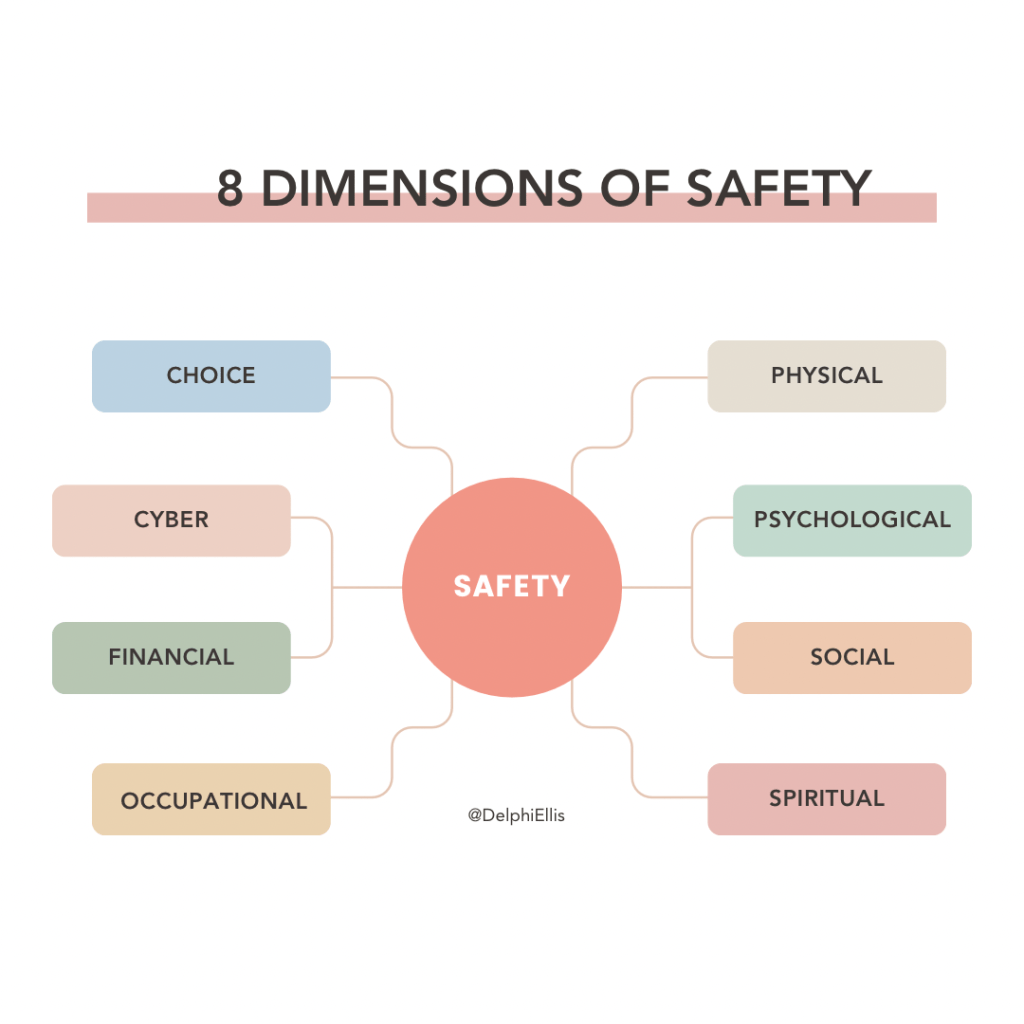
Remember, that like the Circle of Wellness, these dimensions are interconnected; for example if someone doesn’t feel physically safe in one area of their life, it can have a knock on effect on the others.
Physical: this can relate to things like our personal space, as well as how safe we feel at work and in our home. Creating a space for sanctuary – a place where you can rest and unwind – can help, as well as creating an environment with practices like Hygge, that creates a sense of coziness and comfort. This dimension also includes our physical safety in public as well as in social settings (see below) and is therefore also a societal priority; in an enlightened society, everyone has the right to be safe and walk through the world without fear of harm.
Psychological: this is essentially the safety to be able to say “I’m not ok” or “this is not ok”, and again extends to all areas of our lives including work and at home. It can include our mindset and values, and how we may fear judgement or punishment from others. This can also include our self-talk – a noisy inner critic can convince us we are unsafe – and whether we are able to regulate our own emotions.
Social: This can include how safe we feel in social situations; people who prefer quiet spaces or find themselves over stimulated in crowds or large gatherings, may feel unsafe or certainly uncomfortable. It can also relate to how safe we feel to be authentic among our circle, and demonstrates how these dimensions are interconnected if our psychological safety is compromised among friends or family.
Spiritual: This can include the freedom to believe in something bigger than us, and have faith that things are working out for the best. This doesn’t have to be a belief in a specific religion (though it could be) but can also include having a deep reverence for nature, with practices like Shinrin Yoku. If, however, someone is using those beliefs to feel superior, to oppress or harm others, or using spirituality to avoid their own problems they may be Spiritual Bypassing and need to engage in Shadow Work, when it’s safe to do so. Spiritual safety here can also include where our time and particularly energy is going; if we are surrounded by “energy vampires” who leave us feeling drained, we may also feel unsafe in their company.
Occupational: Like other domains, this can link into others, like psychological safety. Environments and toxic workplace cultures can leave some people feeling like it’s not safe enough to say “I’m not ok” or “this is not ok” without fear of punishment or rejection. This can lead to burnout and moral injury, where people try to keep going no matter what, or do the right thing and are sanctioned for it. The Traffic Light System is one method that can help someone measure their capacity to cope, especially when things are tricky at work. Volunteering is a way of building a sense of purpose – and safety – by doing something that matters to us.
Financial: This can relate to the overall dimension of wellness regarding wealth, in terms of how much money a person has (or not), but also how secure they feel perhaps at work or at home. It can also include how much control they have over their spending, especially if they have concerns over gambling or someone else is holding the purse strings.
Cyber: An obvious part of this would be how safe any of our information is online, though in this context it can also impact people who are subjected to abuse online. More than 1 in 3 women have been sent upsetting content and are potentially choosing to step back from social media due to harassment they’ve faced. In her book How to Stay Safe Online, Seyi Akiwowo explains the importance of self-care when navigating digital spaces, while placing an emphasis on society and platforms to do more to address the harms being done. It’s ok to take a break from social media and/or curate the content you see on your timeline.
Choice: All of these areas can impact our ability to make healthy choices; activation (fight or flight) and trauma can happen in spaces where we feel our choices may have been taken away from us. The good news is, and the science tells us, change is possible – we do have choices and if we want something different, we have to do something different. We can do the work of nervous system regulation, like understanding the Window of Tolerance, show ourselves compassion perhaps using affirmations, and take meaningful steps to help ourselves. Above all, it’s ok to put our safety first, while keeping our whole well-being in mind.
Delphi is the author of Answers In The Dark: Grief, Sleep and How Dreams Can Help You Heal, out now on Amazon and Hive. The Helping You Sparkle™ magazine is part of the Helping You Sparkle™ portfolio. References to third parties does not endorse their content. Please read these policies for details.
 Helping You Sparkle™ Magazine
3 thoughts on “Exploring Dimensions of Safety as a Well-being Tool”
Comments are closed.