
Intuition is our ability to know something instinctively without having to discover it or rationalise it intellectually – a deep sense of ‘knowing’ without analytical process. You can’t explain to anyone why – you don’t have statistics or research to back up your perspective. You just ‘know’. Intuition is seen by many as the highest form of intelligence.
– Amisha Ghadiali, Intuition
Over the centuries, we’ve increasingly placed an emphasis on being able to verify information and prove that something is as it appears to be. Science has been an important component in helping us test hypotheses, to develop theories – particularly about how the mind and body work – and in discussing treatments that might help us live longer and more healthily.
The challenge comes when in the pursuit of facts and data, logic and proof, we neglect our spiritual health, and in particular the way it can speak to us: for example, through our conscience, dreams and intuition.
Our natural knowing is talked out of us from an early age. When we saw a parent cry, we knew they were upset but they said they were “just tired” or “had something in their eye”. We trust their authority and we think our intuition is wrong.
Similarly, we begin to doubt our intuition when we are told, in a derogatory way, that we are ‘imagining’ our feelings, ‘over-reacting’ to our pain, or being ‘too sensitive’ (as if that’s a bad thing) when someone else is cruel.
Instinct, Intellect and Intuition
In his book Intuition, the philosopher Osho makes some important distinctions between instinct, intellect and intuition.
He argues that instinct is biological, that it’s the realm of the body. Instinct is something that we all have and which, in the book The Gift of Fear, Gavin De Becker alludes to as our instinctive reactions to get us out of harms way. These are automatic responses, i.e. we don’t have to think about them – thankfully – because it also includes breathing and digesting food. This just happens, our body “knows” what to do. Instinct is therefore primal because it’s fundamentally concerned with our survival.
Intellect is the work of the mind and is in the realm of thinking, logic – and the ego. This works incredibly well to solve mathematical problems, read maps, to remember history lessons and song lyrics, and helps us plan, organise and centre our needs. However, intellect, Osho says, is “for the mundane life”, especially if it ignores the rest.
Intuition is the realm of the soul: of art, creativity, friendship and feeling (which can enable emotion regulation, but specifically feeling on an energetic level, eg. “knowing” as a gut feeling). The soul is also where it’s proposed our conscience resides and is the pure state of awareness, and why mindfulness and meditation are such an important tool for spiritual health. It includes awe and moments of “peak experiences” and a deepened state of connectedness, both to ourselves and “something bigger” (this doesn’t necessarily mean a deity, it could mean nature). Where intellect is “me”, intuition is “we”. It can be considered in the wider realm of energy, consciousness and intention.
We can distinguish intellect from intuition here, as how someone can intellectually talk themselves in to doing something they probably and morally shouldn’t. They can silence their conscience (for a while, at least) by placing emphasis on their “rationale”. Intuition is therefore above the realm of intellect, which also means it’s not something that can be explained; it just “is”. When we start to try and give language to intuition we’ve moved back in to the realm of intellect.
Intuition isn’t woo-woo, but is often labelled as such (at least in the west), probably because it is difficult to prove.
We can’t put intuition in a Petri dish and wait for the results, and some even imply (erroneously) that it sits with “dark forces”. But as De Becker says “Denial is a save-now-pay-later scheme”: denying what we know can be harmful to our health. It might feel like helpful to pretend, or tell ourselves (intellectually) something isn’t “wrong”, but causes a low grade anxiety because we just know the actual truth.
To be clear, there’s nothing “bad” about being cautious, but when we lose the connection between what we know and replace it with what we think we know, decision making can be problematic, even harmful. In his book Blink, Malcolm Gladwell describes it like this:
We live in a world that assumes that the quality of a decision is directly related to the time and effort that went in to making it.
– Malcolm Gladwell, Blink.
In other words, a reliance on intellect with a focus on logic and thinking, can create problems. We may experience difficulty making decisions at one end of the spectrum (perhaps you always tend to think with your head rather than your heart) or, for example, we avoid the Shadow Work of recognising we hate our job, because we “think” it’s what we have to do. We ignore that it gives no sense of meaning or purpose, which impacts our well-being. (A sense of purpose – that benefits the health of the wider world – can be peak soul work).
At the other end of that scale, placing prominence on logic over compassion – control over connection – may well explain the conflict we see in the world today.
People may reject feeling something in its rawest state (like sadness), because to feel it is surrender – acknowledging our own personal truth is uncomfortable – and so we may numb out and push people away. Others may try to militantly rationalise and justify behaviours they claim to be “smart” or “logical” even though they may inevitably harm us all. (Hence me mentioning earlier how some people can rationalise their way out of morally irresponsible choices).
Who Experiences It?
If you ask people, many will acknowledge they believe in intuition, trusting their “hunches” or “gut feelings” (the stomach has actually been referred to as “the second brain“).
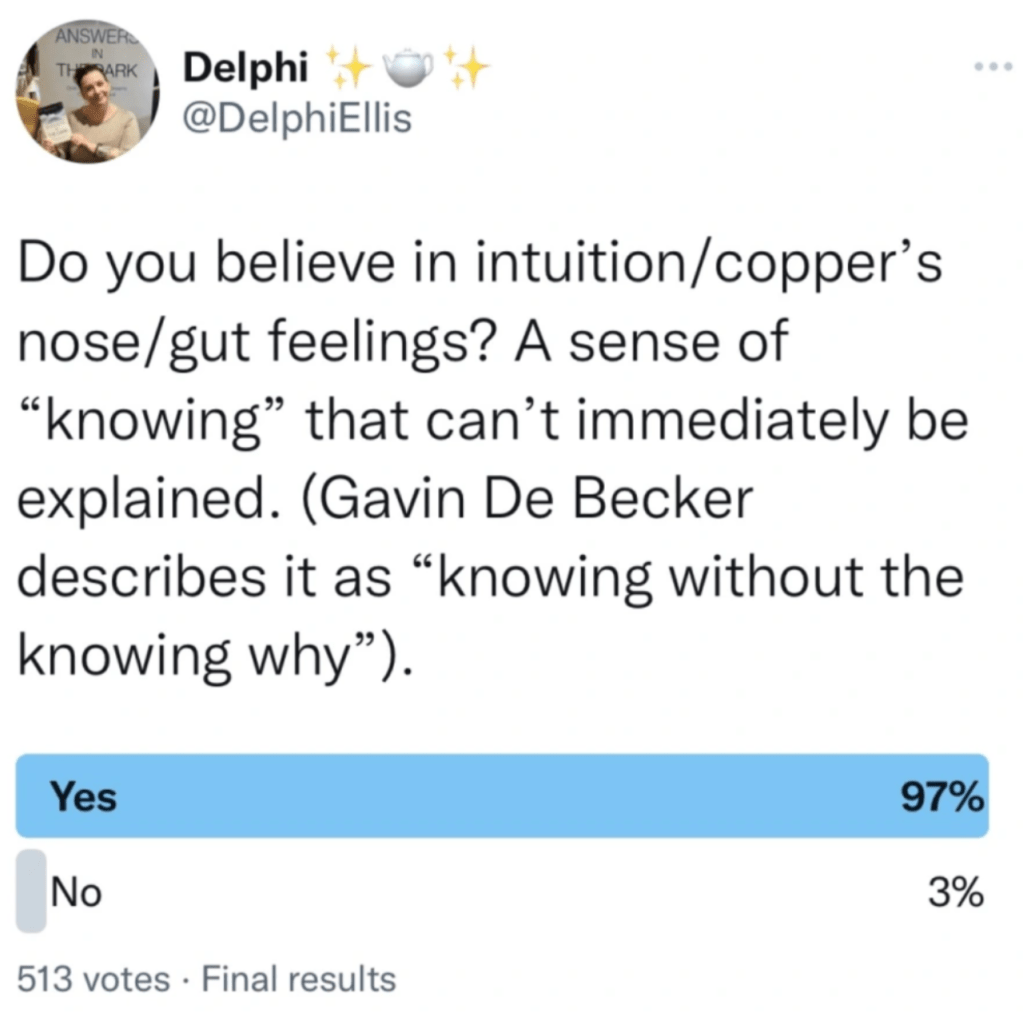
Intuition – like spirituality – is innate, which means we all have the capacity to benefit from it. However, when we disconnect from the soul – when we spend more time in our heads that in our hearts – we may need to work on building it.
Build Your Intuition
Developing our intuition helps us enhance our our Spiritual Intelligence (SQ) described as the highest form of intelligence.
If you’re making the decision to reconnect with your soul and particularly your intuition, you could start small. One way to “test” your intuition is, without looking at the clock, see if you can guess what time it is. If you’re fairly accurate, your intuition may be where it needs to be. You could work on how accurate you are at reading a room’s (or someone’s – with their permission) “energy”. Or you could also try asking yourself what you’d like for dinner and give yourself two choices: then pick one of them and flip a coin giving each answer “heads” or “tails”. If you’re disappointed with the answer you get (against the one you initially chose), your intuition may need recalibrating.
One way to do this is to enhance your senses; start to mindfully appreciate the sights, sounds and textures of your environment and see if this helps you tune in to what “is”. Mindfulness and particularly meditation is described as a portal to intuition, because we begin to see things as they are rather than how we think they “should” be.
You could also consider the role of your dreams – even nightmares – and whether or not there are any messages contained within them that might help build your intuition. I mention in Answers In The Dark that a great way of working with our dreams is by keeping a dream diary.
Intuition and specifically “gut feelings” are recognised as an important gift in business. To make this point, Harvard Business Review suggest that you learn to make the distinction between fear and intuition. Influencers like Mel Robbins use the language of expansion and contraction (see video below) while Glennon Doyle, in her beautiful book Untamed, speaks of ‘cold and warmth’ to help make business decisions.
In her Ted Talk, Jannine Barron says there are three levels to intuition; 1) those ‘hunch’ moments, so make time to look for synchronicities (what Jung described as “meaningful coincidences”), 2) going by inspiration, as opposed to always being dictated to by our thoughts, and 3) trust that your intuition has a place and is valid. She also emphasises the importance of connecting with nature, and practices like Shinrin Yoku, the Japanese tradition of Forest Bathing. She likens intuition to your own internal algorithm, eg. it picks up on your environment and offers you the messages you might ‘need’.
Ultimately it’s a personal choice whether you decide the concept of intuition is worthy of more consideration and whether to embrace (or trust) it. Maybe just don’t think too much about its importance, in case your intellect starts to unhelpfully control every decision you make.
Delphi is the author of Answers In The Dark: Grief, Sleep and How Dreams Can Help You Heal, out now on Amazon and Hive. You might also like Monday Mojo™. The Helping You Sparkle™ magazine is part of the Helping You Sparkle™ portfolio.
© Delphi Ellis 2024; this is an updated version of an article that may appear elsewhere. | Policies
 Helping You Sparkle™ Magazine
4 thoughts on “Should I Trust My Intuition? Why it matters and what might help”
Comments are closed.