
If you feel like the world is more divided, unsettled or challenged than ever, you’re not imagining it.
A flurry of recent reports including Britain Under Strain have highlighted that, certainly in the UK, many people feel as if they’re living in the constant hum of threat.
This is probably not helped by wars being declared in other parts of the world, and the Ministry of Defence stating that they have a £298billion spending package to transform military services to get Britain “war ready”.
So it makes sense if you’ve noticed a shift in your wellbeing. Safety is an important dimension to feeling well; in fact without it, it can feel impossible to flourish and facilitate meaningful change.
However, there is hope. This is where understanding pacifism may help.
What is pacifism?
Pacifism is a lifestyle choice – and a skill.
It sounds simple, put like that, but it’s essentially a decision to show up peacefully in the world – to put the energy into it, that you would like to receive.
Sound idealistic? There are a lot of myths around pacifism. One is that the idea of living peacefully is a utopia – an unrealistic dream that can never be achieved. But that’s because most of us have been raised in a dominance-based culture, and can’t imagine a future without violence.
Thankfully, there is another way.
In her book, Truth or Dare, the ecofeminist Starhawk deacribes three different types of power:
- “power over”, which is what most of us understand as domination and control of others,
- “power with”, which is forged in community collaboration, mutual care and cohesion, and
- “power within”, the personal autonomy to make choices as part of our learning and development.
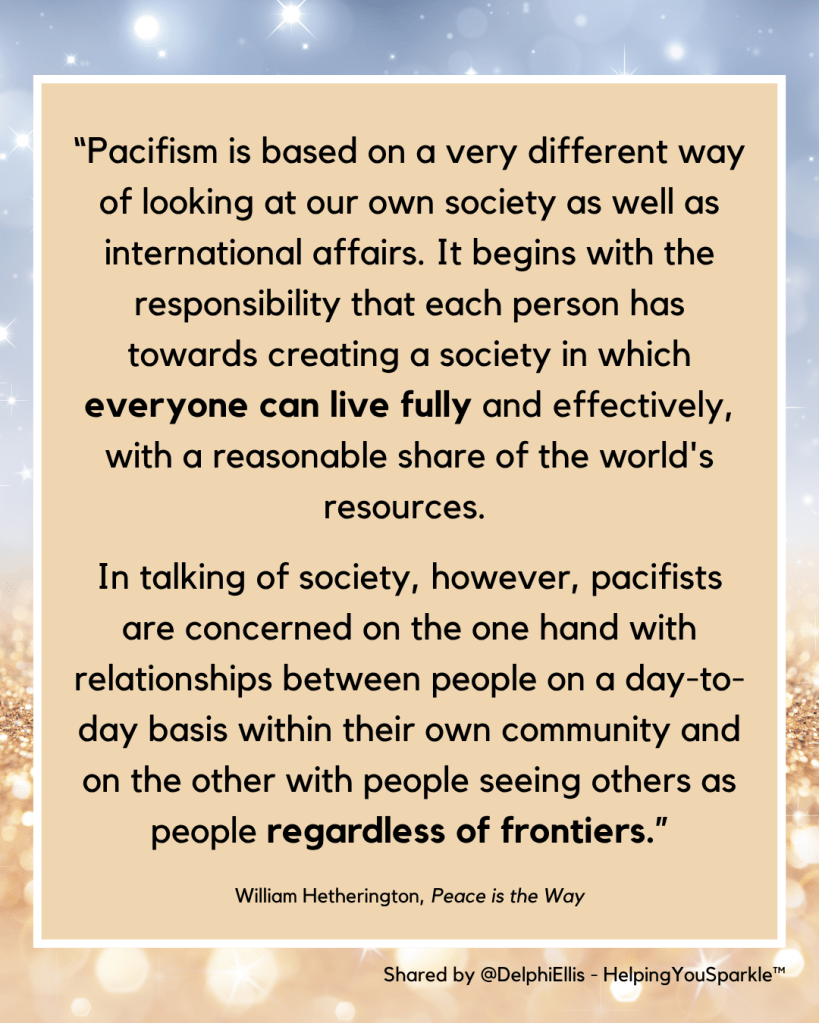
Pacifism is concerned with the last two: community and the individual living within it. It puts learning and connection (to our neighbourhood and to ourselves) above power, status and control.
It’s a daily choice to show up in the ways we’d like the world to be. It’s a practice but also requires knowledge and wisdom, including skills in nonviolent communication and conflict transformation.
It’s not being a pushover, in fact it’s knowing when and how to set boundaries. It’s not cowardice, because it takes immense moral courage and effort to challenge someone’s harmful attitude or meet it with compassionate curiosity instead of aggression, especially in a world where we might feel we are at war with each other – and ourselves.
I was taught that keeping quiet “kept the peace”… until I asked myself “whose peace am I keeping?” – Dr. Thema Bryant (paraphrased).
The role of Spiritual Health
Living peacefully – and nonviolently – is also key to our spiritual health and in building our spiritual intelligence (SQ). This will particularly align with you, if part of your approach is to follow the Golden Rule – to treat others as you’d wish to be treated: the philosophy of do no harm.
None of this is easy though, so it’s important to pace yourself as you make this important lifestyle change in choosing peace every day.
Here are some tips that might help.
Tips for Living Peacefully
- Choose “positive peace”. This is a concept that recognises that just the absence of violence isn’t always peace (that’s known as “negative peace”, especially when cultural (assumptions, prejudice) and systemic (like policy) harms can lead to harm itself. An example of this!here, might be when you practice self-care, are you also exploring the reasons why you might need it? Is it workload, pressure to succeed, or trying to do too much with too little? To what extent are societal norms and expectations exhausting you?
- Choose your values. This is very much about knowing what matters to you. It might be recognising the importance of integrity and moral courage – doing the right thing, even when it’s hard – or prioritising compassion, friendliness and generosity in the company of others. Pacifism itself isn’t just a value, though, it’s also a principle – an unshakeable decision to choose nonviolence in every interaction, including the way you speak.
- Choose your practice: Pacifism is a daily commitment to living peacefully; it’s a skill we have to cultivate. You might set the intention to start small by promising to be kind to yourself every day, or perhaps demonstrate one act of kindness towards someone else. You might do something as simple as making sure you say please and thank you, or make efforts to communicate without bias or prejudice. You might also need to know your triggers, and practice how you will choose to respond if something – or someone – upsets you (see point 5).
- Choose safety. When you choose pacifism you’re saying that you’re a safe person to spend time with. Your presence creates calm not chaos, and a vibe others may be naturally drawn to and find healing. This may also mean having to reflect on your own social circle though – the company you keep – and whether or not they support your decision to prioritise peace. For this reason, you may also have to pick your battles, certainly initially, and if conversations are tricky, put your physical safety first too.
- Choose inner peace. Whether you find it hard to show tolerance for the outside world or not, it’s essential that you take care of your own wellbeing. To start your persona action plan, you could ask yourself the question “If a year from now I was living with inner and outer peace, what would my life look like?” You can then work backwards to think about what might need to change. This might also mean doing the work of understanding your triggers, and particularly any themes around reactivity, say around certain people or places. This is where Shadow Work can be valuable, though as always, only do what feels healthy for you.
Remember, choosing peace can be hard at first, certainly unfamiliar territory, because it may require a fundamental shift in the way you think, feel and behave. But, if we want something different, we have to do something different.
So if we want a world that’s calmer, kinder and more enjoyable to live in, it makes sense to think about whether we’re showing up that way too.
© Copyright Delphi Ellis 2026
 Helping You Sparkle™ Magazine
You must be logged in to post a comment.